

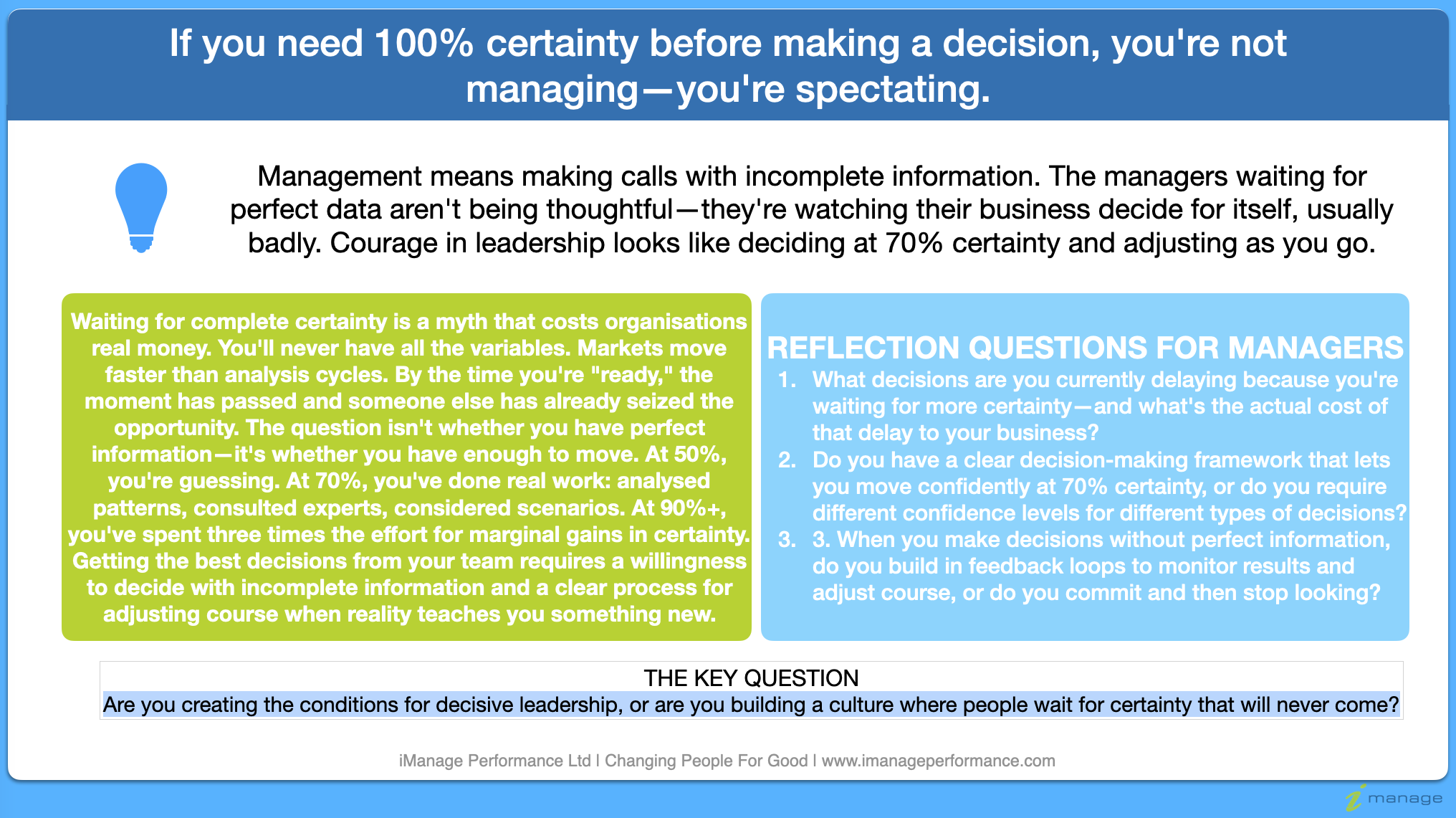
There’s a fundamental difference between managing and spectating. One requires decisions. The other requires only observation.
If you find yourself waiting for perfect information before making a call, you’re not actually managing. You’re standing on the sidelines, letting circumstances decide for you—and rarely in your favour.
The Perfect Data Trap
Managers often tell themselves they need more information. Just one more report. One more quarter of data. One more stakeholder opinion. The request seems reasonable. It feels responsible. After all, shouldn’t leaders make informed decisions?
The problem is that “more information” is endless. In today’s business environment, you could gather data indefinitely. Markets shift faster than analysis cycles. Competitors don’t wait for your certainty. And meanwhile, the decision—the one you’ve been delaying—is already being made for you by inaction.
Waiting for 100% certainty isn’t rigour. It’s paralysis dressed up as prudence.
Consider what happens when you delay: opportunities close. Market windows shut. Your team loses momentum. Competitors move faster. The cost of indecision compounds daily, yet it rarely shows up as a line item on a decision memo. It’s invisible, which makes it dangerous.
The Math of Incomplete Information
Here’s what experienced managers know: almost no significant decision comes with complete information. Never has, never will. Business moves too fast, the future is inherently uncertain, and you’ll always be missing *something*.
This isn’t a flaw in the process. It’s the reality of leadership.
The real question isn’t whether you have enough information—it’s whether you have *enough to move*. There’s a meaningful difference.
At 50% confidence, you’re guessing. Keep gathering data.
At 70% confidence, you’ve done real work. You’ve analysed patterns, consulted experts, considered scenarios, and stress-tested your thinking. You’ve reduced uncertainty meaningfully. This is where decisions get made.
At 90% confidence? You’ve spent three times the effort for a marginal increase in certainty. You’ve sacrificed speed and momentum for a false sense of security.
At 100% confidence? You’re not a manager anymore. You’re a spectator watching someone else make your decision.
Courage Looks Like 70%
The best managers aren’t the ones with the most data. They’re the ones with clear decision-making frameworks and the courage to act when conditions are good enough.
This courage comes from several places:
First, it comes from knowing your process is sound. You’ve built a system for gathering relevant information quickly, soliciting diverse perspectives, and identifying the key variables that matter. You’re not guessing—you’re making informed judgments based on structured thinking.
Second, it comes from accepting that you’ll sometimes be wrong—and that’s fine. A manager who never makes mistakes either isn’t taking enough risk or isn’t being honest about their track record. The goal isn’t perfection; it’s a high hit rate over time. Missing 30% of the variables occasionally is a reasonable trade-off for moving decisively.
Third, it comes from understanding that the cost of delay exceeds the cost of imperfection. In most business situations, a good decision made quickly beats a perfect decision made too late. Speed creates its own advantages: market position, team momentum, learning from actual results.
The Role of Rapid Adjustment
Here’s what separates great decision-makers from the paralysed: they don’t see decisions as irreversible.
When you move at 70% confidence, you leave room for course correction. You build in feedback loops. You monitor what matters. If you were wrong—and sometimes you will be—you adjust. This is how learning happens.
The manager waiting for 100% certainty has a different problem: by the time they’re ready to act, circumstances have changed so much that their analysis no longer applies. They’re perpetually chasing a moving target.
The manager who moves at 70% is already adjusting based on real-world results.
#What Are You Delaying?
This is the question that matters most right now, for you.
Is there a decision sitting on your desk that you’ve convinced yourself needs more analysis? A hiring decision. A strategic pivot. An operational change. A resource allocation.
Ask yourself honestly: are you waiting for information that will actually change your mind, or are you waiting for certainty that will never come?
If you’ve done reasonable analysis, consulted your team, considered the downside, and thought through how you’d adjust if you were wrong—you might already be at 70%.
The courage to decide at 70% certainty isn’t recklessness. It’s leadership. It’s the difference between managing your business and spectating while it manages itself.