

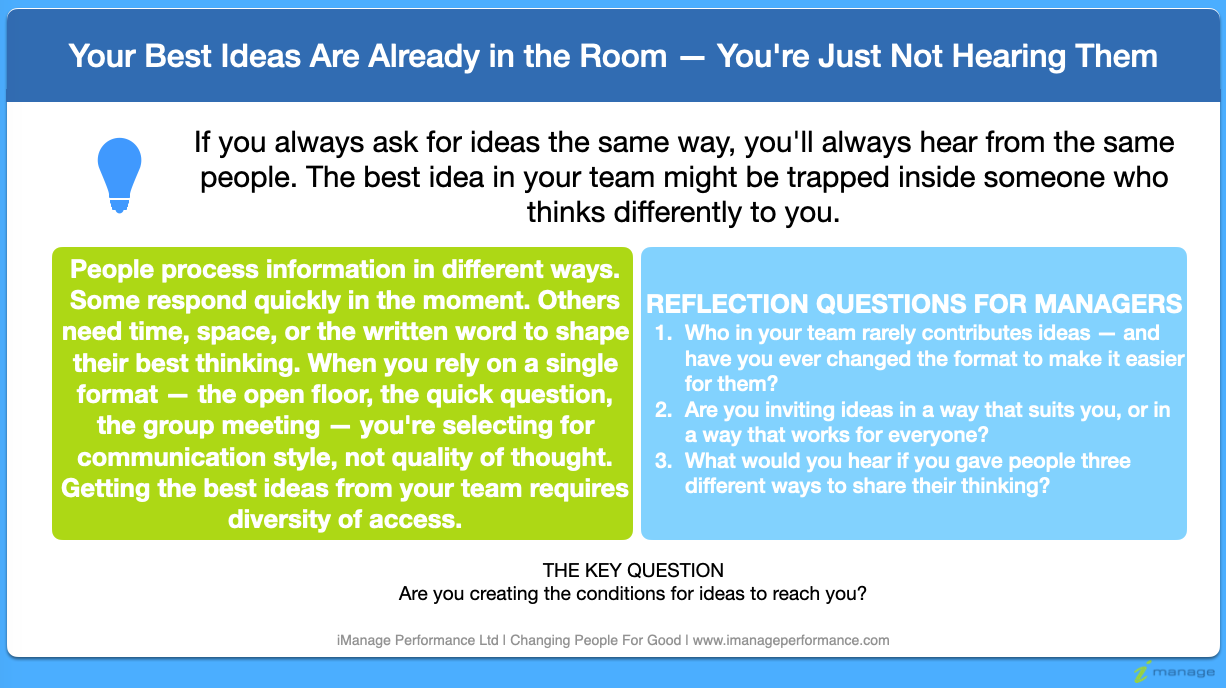
The best ideas in your team might already exist — they’re just trapped inside someone who thinks differently to you.
That’s a provocative thought. But sit with it for a moment. In your last team meeting, who spoke up? Who offered a suggestion, challenged a proposal, or floated a new angle? And who stayed quiet? Because the people who said nothing — they may not have had nothing to say. They may simply have had no accessible way to say it.
This is the quiet, underappreciated problem that sits beneath a lot of management conversations about innovation, engagement, and performance. It’s not really about whether your team has good ideas. It almost certainly does. The real question is whether your environment — your communication style, your meeting format, your default ways of operating — is structured in a way that allows those ideas to actually reach you.
The Problem with One-Size Thinking
Most managers have a dominant style when it comes to ideas-sharing. Maybe you love a lively, fast-moving brainstorm. Maybe you prefer a structured agenda item. Maybe you just ask the question in the room and expect responses. The way you prefer to receive information feels natural to you — because it’s your style. But here’s the problem: it’s yours, not everyone’s.
Research consistently shows that people differ significantly in how they process information and contribute ideas. In their widely cited Harvard Business Review study, Alison Reynolds and David Lewis (2017) found that teams with higher cognitive diversity — defined as differences in perspective and ways of processing information — solved problems faster and more effectively than teams with lower cognitive diversity. The catch? Cognitive diversity is easily suppressed when the environment only rewards one style of thinking or communicating.
Communication style isn’t a neutral thing. When a manager consistently favours verbal, in-the-moment responses, they are — often without realising it — creating a system that selects for a certain kind of contributor. The quick thinker. The confident speaker. The person who is comfortable making their thoughts public before they’ve fully formed them. That’s a real and valuable style. But it’s not the only one. And many of your most original thinkers won’t operate that way.
Introverts, Reflectors, and the People Who Need a Moment
In her landmark book Quiet: The Power of Introverts in a World That Can’t Stop Talking, Susan Cain (2012) makes a compelling case that modern workplaces are disproportionately designed for extroverts — open-plan offices, group brainstorms, and the expectation of real-time verbal engagement. This design, she argues, systematically disadvantages introverts, who often think more deeply and carefully but need time and space to do so.
The implication for managers is significant. If you only ever ask for ideas out loud, in a group, on the spot, you are structurally less likely to hear from the people in your team who do their best thinking in private, in writing, or after a period of reflection. And those people may have the most considered, fully-formed, genuinely novel perspectives to offer.
This isn’t just about introversion. It also connects to neurodiversity, cognitive processing differences, and individual working preferences. Some people will respond to a question in seconds. Others will have a brilliant answer — but not until they’ve slept on it, written it down, or had a one-to-one conversation rather than performing in front of the group. The current communication format you’re using determines which of these people you actually hear from.
Cognitive Diversity Is Only Valuable If You Can Access It
Matthew Syed’s book Rebel Ideas: The Power of Diverse Thinking (2019) makes a striking argument: the most dangerous teams are not the ones with low intelligence, but the ones where everyone thinks alike. When teams are made up of people with similar cognitive styles and perspectives, they share the same blind spots. Ideas go unchallenged. Groupthink flourishes. The unconventional answer — the one that might actually solve the problem — never surfaces because the environment wasn’t designed to produce it.
Syed uses the term “cognitive diversity” in a specific sense: not just demographic difference, but real differences in the way people frame problems, interpret information, and generate solutions. The challenge for managers is that this kind of diversity is invisible until you create the conditions for it to emerge. You can have a team full of genuinely different thinkers and still end up hearing from the same two or three people every time — because only they find your current setup navigable.
Professor Scott Page (2007), in The Difference, takes this further with mathematical rigour, demonstrating that diverse problem-solving groups consistently outperform groups of individually high-performing but cognitively similar individuals. But again, the prerequisite is access — a structure that lets those diverse perspectives actually enter the room.
What “Diversity of Access” Looks Like in Practice
So what do you actually do about this? The concept is simple: don’t rely on a single channel for ideas. Create multiple, varied pathways by which someone — anyone — can contribute a thought, raise a concern, or share a suggestion. Here are some practical starting points.
Before the meeting, send the question. If you know you’re going to be discussing a particular challenge or decision, share it in advance. This gives reflective thinkers the time they need to arrive with something to say. It shifts the advantage away from whoever happens to think fastest under pressure, and toward whoever has thought most carefully.
Invite written input as a default. Not just as a fallback for the quiet ones, but as a genuine, valued channel for everyone. A shared document, a Slack thread, a quick email — these aren’t lesser forms of contribution. For many people, they’re the form in which thinking is clearest. Amy Edmondson, whose work on psychological safety (1999, 2018) has become foundational in management research, notes that people are significantly more likely to contribute ideas and flag concerns when they feel they can do so without social risk. Writing, done well, lowers that risk.
Use anonymous contribution tools for high-stakes topics. Platforms like Mentimeter, Slido, or even a simple anonymous Google Form can surface ideas that people would never say out loud — not because they’re afraid, but because they value privacy, dislike confrontation, or simply don’t perform well in group settings. The idea is just as valuable regardless of who it came from.
Follow up individually. Not everyone will use whatever channel you provide. Some people will need a direct, low-pressure, one-to-one conversation where the stakes feel lower and the social dynamics are simpler. A regular check-in that genuinely invites ideas — not just updates — can be the most productive channel of all for certain people on your team.
Be explicit about what you’re doing and why. Tell your team that you’re trying to make it easier for everyone to contribute, and that you value different ways of thinking and sharing. This kind of meta-communication builds the psychological safety that Edmondson describes as essential for learning behaviour and genuine idea-sharing. It signals that you’re not just going through the motions — you actually want to hear from people.
The Uncomfortable Question
There’s a harder version of all this that’s worth sitting with. When you think about the ideas that have made it through to you — the suggestions that got considered, the voices that got heard — what do those contributions have in common? Are they all coming from the same few people? The confident ones, the quick ones, the ones whose style happens to match yours?
If so, it’s worth asking honestly: whose ideas are you missing? Who on your team has never quite found the right moment, or the right format, or the right level of comfort to share what they’re actually thinking?
Adam Grant, in Hidden Potential (2023), argues that some of the most capable people are those who don’t immediately look or sound like the conventional high performer. Their contribution requires a different kind of cultivation — one that starts with recognising that your current system may be selecting for presentation style rather than quality of thought.
A Final Thought
Creating diversity of access isn’t about lowering standards or making meetings interminable with every conceivable format. It’s about recognising that the way you currently run things has its own invisible architecture — one that favours some people and disadvantages others, not through any bad intent, but simply because no-one has questioned it.
The best ideas in your team might already be there. They’re just waiting for a door that fits.
References
Cain, S. (2012). Quiet: The Power of Introverts in a World That Can’t Stop Talking. Crown Publishers.
Edmondson, A. C. (1999). Psychological safety and learning behavior in work teams. Administrative Science Quarterly, 44(2), 350–383.
Edmondson, A. C. (2018). The Fearless Organization: Creating Psychological Safety in the Workplace for Learning, Innovation, and Growth. Wiley.
Grant, A. (2023). Hidden Potential: The Science of Achieving Greater Things. Viking.
Page, S. E. (2007). The Difference: How the Power of Diversity Creates Better Groups, Firms, Schools, and Societies. Princeton University Press.
Reynolds, A., & Lewis, D. (2017). Teams solve problems faster when they’re more cognitively diverse. Harvard Business Review. https://hbr.org/2017/03/teams-solve-problems-faster-when-theyre-more-cognitively-diverse
Syed, M. (2019). Rebel Ideas: The Power of Diverse Thinking. John Murray.