

“Just focus.”
“Try harder.”
“You need to concentrate better.”
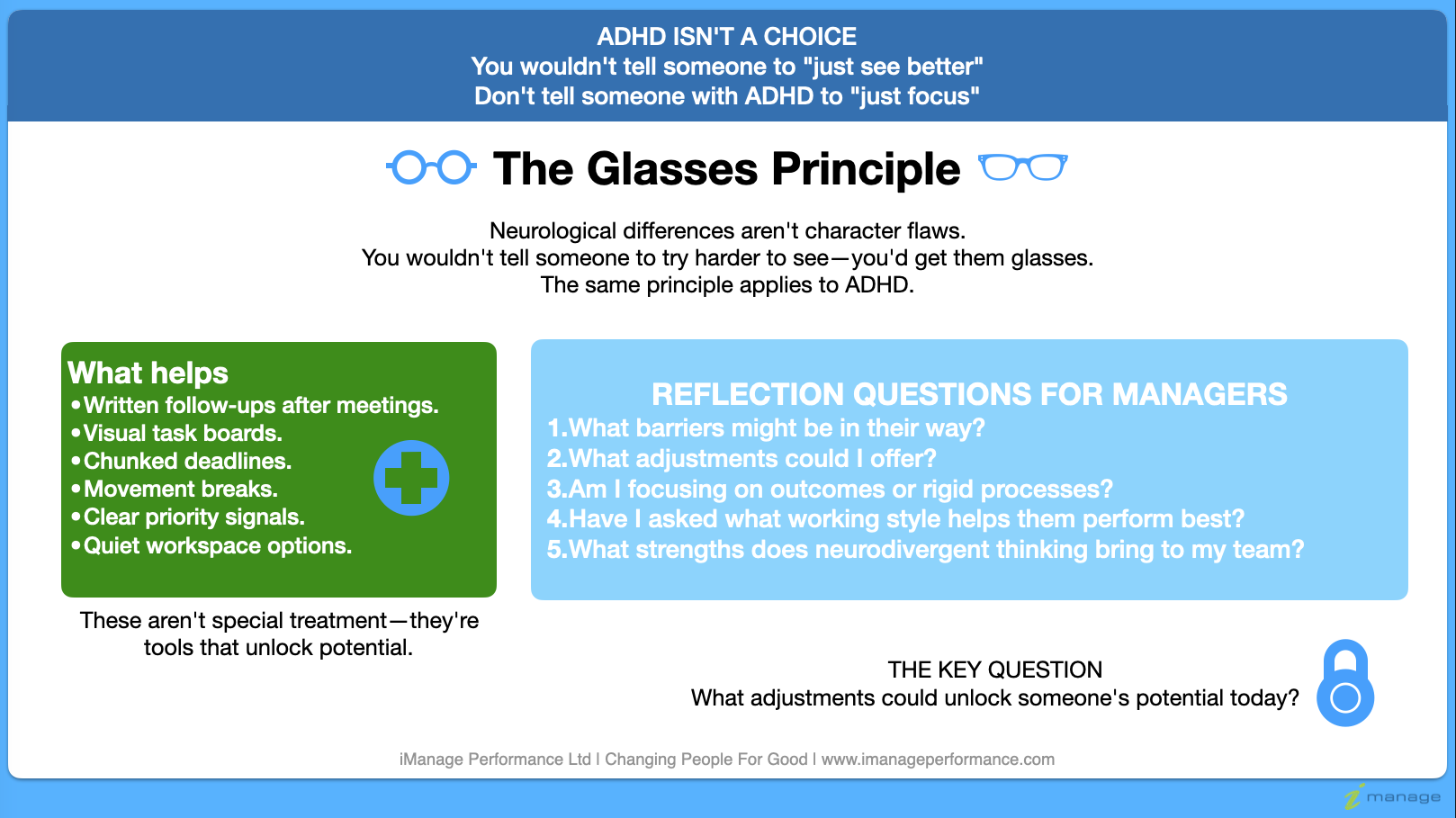
If you’ve ever said these words to someone with ADHD, you’ve made the same mistake as telling someone with poor eyesight to “just see better.”
The Fundamental Misunderstanding
ADHD isn’t a motivation problem. It’s not about effort, discipline, or character. It’s a neurological difference in how the brain regulates attention, processes information, and manages executive functions.
When we frame it as a choice or a character flaw, we fundamentally misunderstand what we’re dealing with—and we miss the opportunity to actually help.
The Glasses Principle
Think about vision impairment for a moment. We don’t:
– Tell people to squint harder
– Question their commitment to seeing clearly
– Suggest they lack the willpower to focus their eyes
– Imply that needing glasses reflects poorly on their character
Instead, we provide an accommodation—glasses—that enables them to function at their full potential.
The same principle applies to ADHD and other neurological differences.
What Real Support Looks Like
Rather than asking people to overcome their neurology through sheer force of will, we need to ask: **What adjustments could unlock someone’s potential today?**
For someone with ADHD, practical accommodations might include:
- Written follow-ups after verbal meetings to capture key actions
- Visual task boards instead of text-heavy lists
- Body-doubling opportunities (working alongside someone for accountability)
- Chunked deadlines rather than single distant due dates
- Movement breaks built into the workday
- Noise-cancelling headphones or quiet workspace options
- Clear priority signals when multiple tasks compete for attention
These aren’t special treatment. They’re the equivalent of glasses—tools that enable someone to demonstrate their actual capabilities.
The Cost of Misunderstanding
When we treat neurological differences as character issues:
- We lose talented people who simply needed a different approach
- We create unnecessary stress and anxiety
- We damage confidence and self-belief
- We miss out on diverse thinking styles that strengthen teams
- We perpetuate stigma that prevents people from seeking support
The Leadership Challenge
As managers and leaders, our job isn’t to make everyone fit the same mould. It’s to create conditions where diverse talents can flourish.
This means:
1. Educating ourselves about neurological differences
2. Asking what accommodations would help, rather than assuming
3. Normalising different working styles and needs
4. Focusing on outcomes rather than rigid processes
5. Celebrating the strengths that come with neurodivergent thinking
Moving Forward
The next time you’re tempted to tell someone to “just focus,” pause and reframe:
- What barriers might be in their way?
- What adjustments could I offer?
- How can I set them up for success rather than struggle?
Neurological differences aren’t deficits to overcome—they’re variations to accommodate, just like we do with vision, hearing, or mobility.
The question isn’t whether someone can focus. The question is: have we given them the right tools to show us what they’re capable of?
—
Your Turn
What adjustments have you seen unlock someone’s potential in your workplace? What simple changes could you implement this week to better support neurodivergent team members?
Let’s shift the conversation from “try harder” to “work smarter”—together.